While the inspectors and the Budapest metro forge a comprehensive aesthetic, the film actually is dissects what happens when you build a system that no longer has to justify its own existence, and then drop people into it who are searching for their own identity. The inspectors aren’t enforcing anything meaningful; they’re performing authority. And the key point is that the performance is all that’s left.
Nimrod Antal quickly strips away any illusion that this job matters. There’s no larger societal function presented in a convincing way, no sense that what they’re doing contributes to anything beyond maintaining the fiction of order. Rules exist, their reason does not.
That’s why Kontroll lands harder than it probably should. Strip away the metro, the uniforms, the specific job, and what you’re left with is something uncomfortably recognizable: people clinging to roles that no longer make sense, performing structures that have outlived their purpose, competing inside systems that offer no real reward beyond the illusion of significance.
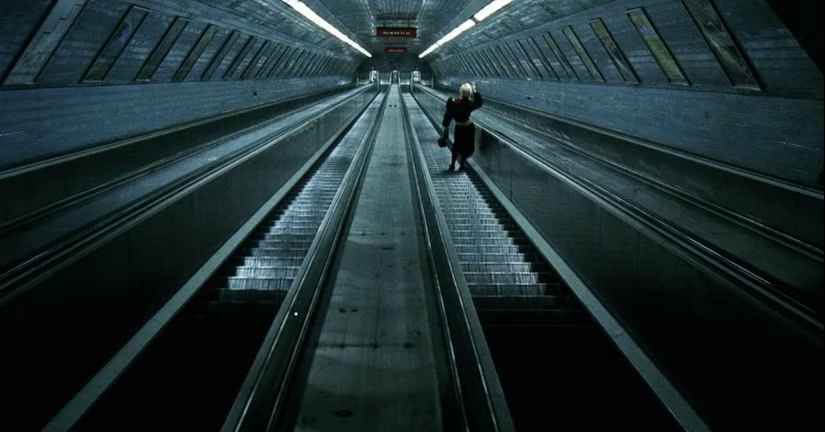
Bulscu and the hooded figure are definitely connected. So much so, that the authorities suspect Bulscú of killing Bootsie at the end of an impressive chase sequence. The hooded figure gives a lot of room for discussion, ultimately the angle we settled on is that Bulscú is the hooded figure. Bulcsú is passive, stagnant, fully adapted to the system. The hooded figure is the opposite: pure action, pure disruption. If you map them together, they function like two halves of the same state. The fact that the hooded figure dies while chasing Bulcsú is key. If they’re linked, that moment reads less like a victory over an external threat and more like the death of that particular set of (self)destructive traits. After the death of the hooded figure, an angel awaits at the bottom of a escalator leading up into a blinding light. Salvation? Maybe. The question here is whether the film truly earns this ending.
If this is purgatory, then ascent should require transformation. Recognition. A break from the loop that’s been established the entire film. And Kontroll gets close—but arguably leans a bit too hard on symbolism to carry that shift. So the ending sits in an interesting space. If you take it at face value, Bulcsú escapes overcomes purgatory and ascends. Did he really do enough to justify this? Maybe facing our own demons is truly the biggest challenge of them all